
AI your organization can trust, trace, and defend
Biolytica helps life science organizations automate scientific workflows and deploy AI that produces outputs they can stand behind. We design governed automation infrastructure, domain-specific knowledge graphs, and AI systems for institutions where provenance, traceability, and accountability are built into the architecture.
The organizations that win with AI are the ones that can defend what their automation produced
Government agencies, research institutions, genomics laboratories, forensic programs, and environmental monitoring organizations all need faster, more automated workflows. They also operate in regulated, forensic, and scientific environments where automation requires governance controls, provenance tracking, and audit trails built in from the start. Sequences, specimens, evidence chains, regulatory records, and unpublished research are exactly the kinds of assets that make automation powerful. They are also exactly the kinds of assets that cannot leave the building.
Governed AI deployment solves this. Models run inside your infrastructure. Data stays under your control. Outputs are auditable and traceable. The capability you need does not require the exposure you cannot accept.
Biolytica's experience building institutional systems for regulated environments (forensic programs, government agencies, research consortia) means we understand these constraints from the inside, not as edge cases to be accommodated after the fact.
Government environmental agencies and regulatory bodies
Genomics laboratories, DNA barcoding programs, and biodiversity research institutes
Forensic and wildlife crime investigation programs
Research institutes and university centers managing sensitive scientific data
Conservation and environmental monitoring organizations with field and sensor data
The knowledge graph is what makes governed AI reliable in your domain
Any organization can deploy a private language model. What determines whether that model produces reliable, defensible outputs in your domain is the knowledge infrastructure around it. A domain-specific knowledge graph encodes the entities, relationships, provenance chains, and interpretive frameworks that matter. The accumulated understanding that cannot be reconstructed from a public training set or replicated through prompting.
For life science institutions, this means structured representations of species relationships, sequence provenance, methodological standards, evidence hierarchies, regulatory requirements, and institutional workflows. When a model reasons over this graph rather than over unstructured documents, the outputs are grounded, not generated.
Biolytica's depth in biodiversity informatics means we know which relationships matter and how to encode them accurately. That expertise is the foundation the knowledge graph is built on.
Entity and Relationship Modeling
Domain-specific entities, hierarchies, and relationships designed to reflect how knowledge actually works in your field. Not generic ontology frameworks applied from the outside.
Provenance and Evidence Chains
Every node and relationship traces to its source. Outputs from AI systems built on this graph are explainable, citable, and defensible in regulatory or scientific review.
Retrieval-Augmented Generation
Private language models query the knowledge graph at inference time, grounding responses in your institutional knowledge rather than relying on potentially outdated or inapplicable training data.
Incremental Updates
The graph grows as your knowledge grows. New records, publications, and data flows are integrated without retraining the underlying model.
Governed AI systems for institutional settings
The full stack from data readiness to governed inference, designed for institutions where the requirements go beyond what generic AI deployment provides.
A working governed AI deployment running inside your infrastructure. That includes a domain-specific knowledge graph built from your data, a private model running against it, evaluation reports for the tasks you care about, validated agent workflows where they apply, and documentation your team can maintain after we hand off.
Private & Local Model Deployment
Local and private-cloud model deployment within your infrastructure. Models selected and configured for your data types, compute constraints, and performance requirements.
Knowledge Graph Construction
Domain-specific knowledge graphs built from your data, literature, and institutional workflows. The foundation that makes AI outputs reliable and traceable in your context.
Domain Adaptation & Fine-Tuning
Fine-tuning where it adds value; retrieval, structured prompting, and evaluation pipelines where it does not. The right approach chosen for your data, risk profile, and operational goals.
Governed Agentic Workflows
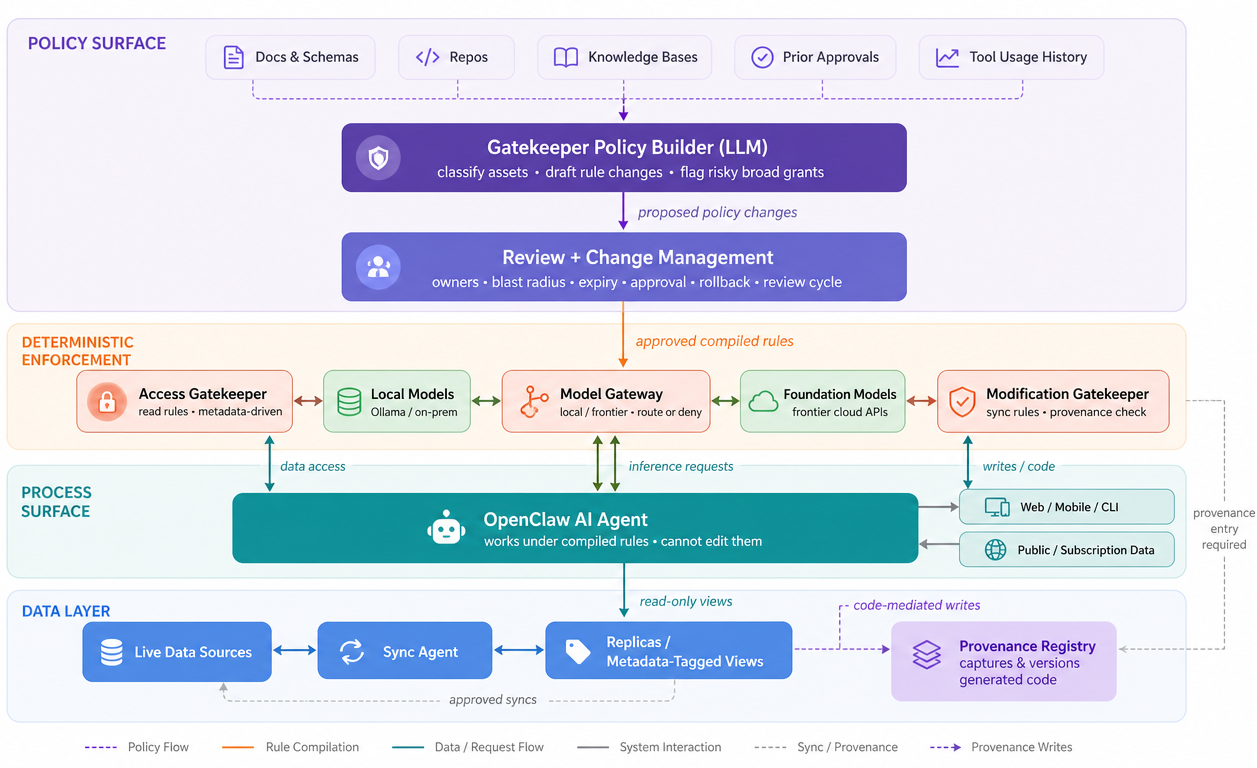
Agentic systems designed for repeatable tasks inside controlled scientific and operational workflows. Agents handle curation, quality control, evidence synthesis, reporting, and knowledge retrieval while preserving review, provenance, and accountability at every step. The value is not the agent. It is the system architecture around it.
Ready to automate workflows your organization can defend?
Engagements begin with a scoping conversation to understand your data environment, governance requirements, and the specific workflows you need to automate reliably.